
Click on this link for all the posts on growing >
Traditional agricultural knowledge and techniques have already created a productive environment of this quinta, even if it suffered a decade or two of neglect before we took it on. It remains for us to design in the gaps and avoid the places where tradition has lapsed into modern dependence on harmful chemicals. Or to change long-held beliefs and practices which have been found questionable in the light of evolving soil science.
We’re aiming for a fertile partnership between permaculture principles and the best of local knowledge. Our most notable deviation will be in practicing “no-till” methods as far as possible, aiming to restore the natural fertility and life in the soil by what we grow in it and spread on top of it, rather than what we dig into it, and following the examples of people like Masanobu Fukuoka and Sepp Holzer in their natural farming methods.
“I truly believe that as long as we have not found peace with the soil, we won’t find peace above the ground. That as long as we justify the exploitation of an organism, other exploitations will follow and we will remain parasites, consuming more than participating and spiralling into entropy until we commit mass suicide.”
Emilia Hazelip
It takes time to get to know the land in all its seasons – where the light falls at different times of the year, where the water flows, where the wind blows, what grows where, what thrives, what doesn’t, what changes, what stays the same – so we take mostly small steps, with lots of observation and research and even more trial and error.
Terraces
The terraces are planted with fruit and nut trees and vines throughout. It took a good two years to discover what we had growing – not all trees were fruiting in any one year and a lot needed attention before returning to health and productivity.
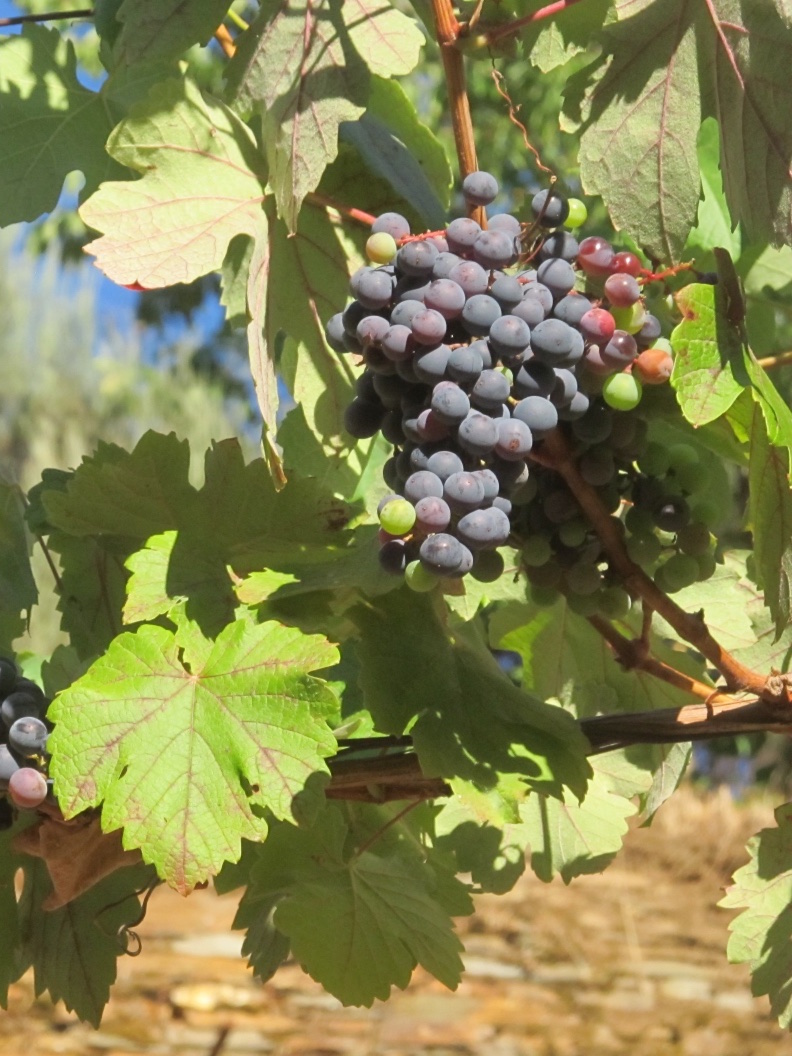
When we bought the quinta, many of the younger fruit trees were not particularly vigorous and showed signs of drought stress. Some were suffering from peach leaf curl (Taphrina deformans) and there was a problem with brown rot thanks to a build-up of spore reserves in infected fruit remaining on neglected trees. The priority to begin with was a lot of observation, selective pruning, removing spore reserves, keeping the bracken and brambles within bounds and putting in water lines and swales to ensure trees had sufficient water, supportive companion plants like comfrey (Symphytum officinale), and a good nutritive mulch to help them recover and grow more strongly. We also sowed a lot of white clover and other leguminous nitrogen-fixers about the place.
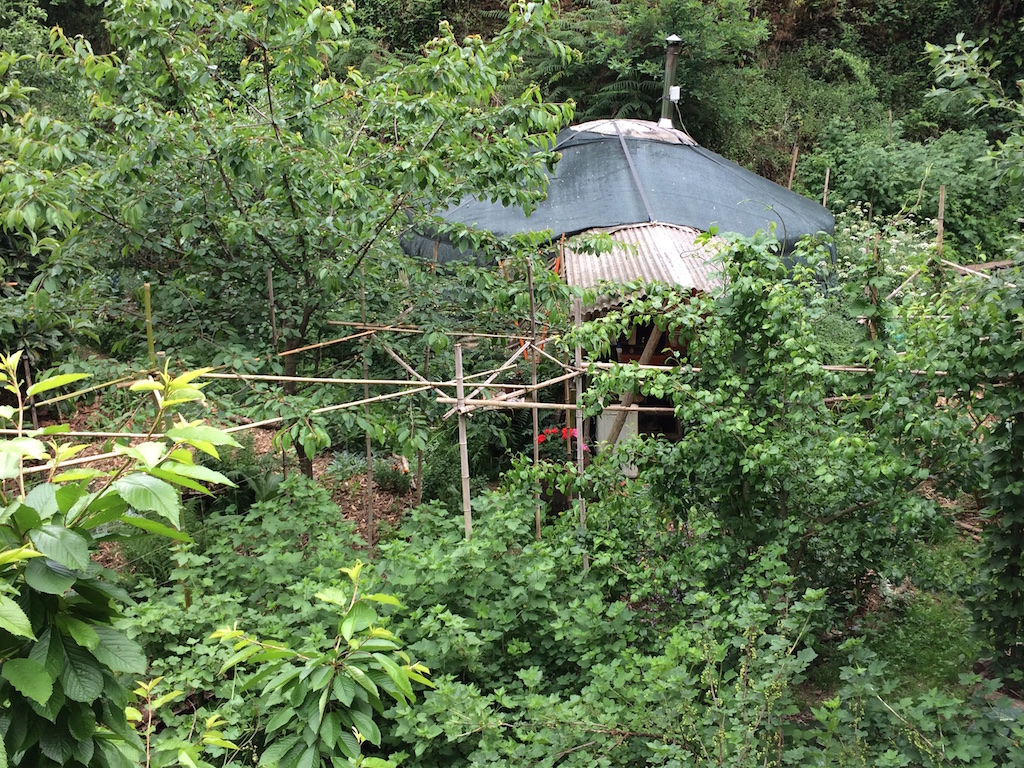
As time went on, we started turning most of our growing area into a low maintenance forest garden with smaller areas dedicated exclusively to annual vegetables.
I had originally envisaged vegetables taking more of a back seat in the first couple of years with the work required elsewhere getting basic facilities sorted, but the urge to get growing was too irresistible and we soon realised that to establish what grows well where, with what and how will also take time, observation and experimentation – an ongoing process that will likely keep us occupied for decades.

There were originally only 9 widely spaced olive trees on the quinta which isn’t enough to provide for eating, self-sufficiency in oil, and enough left over to make all our own soap and such. Some more trees have been added, though more are needed. There were no figs, so these have been planted, as have nectarines and apricots. I’d also like to try growing avocados. Two were doing very well next to the greenhouse before the fires.
Sorting out water supply and irrigation was a priority. See the Water project page for more details.
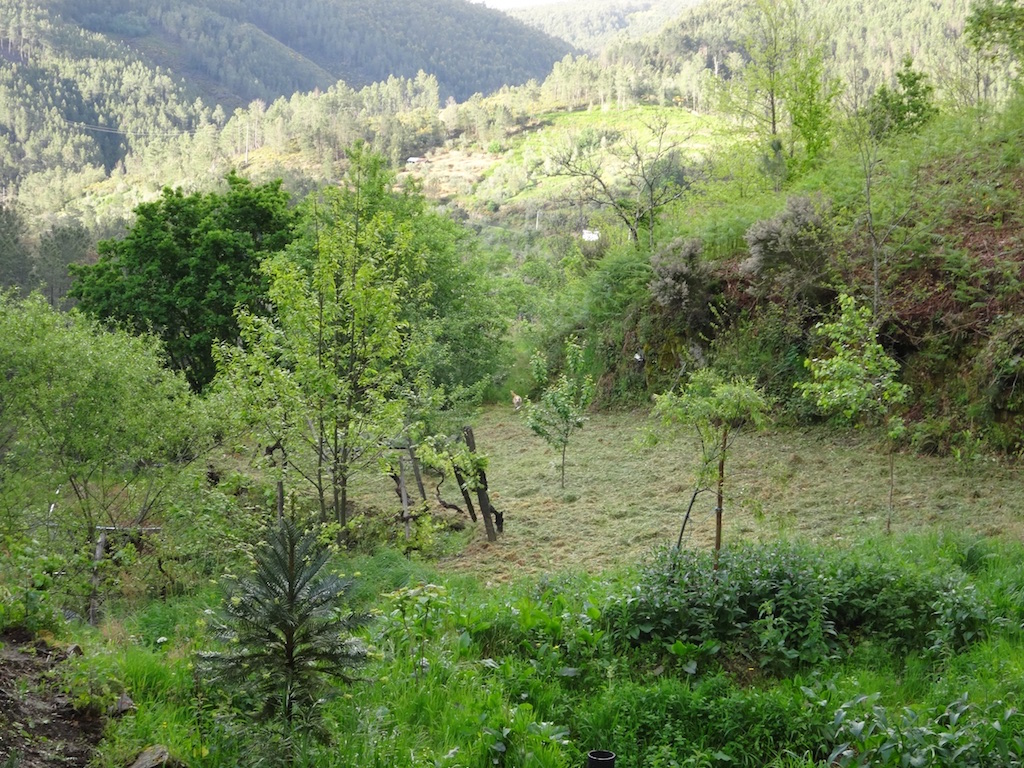
There are considerable microclimatic variations across the site. The aspect varies from west through north right round to south east, though being situated one third of the way up the eastern slopes of a mountain ridge with a ridge also to the south, most of the quinta is effectively north-facing in winter and only really open to the east. There’s also quite a temperature gradient where the stream pulls cold air down the valley and deciduous trees in this area are at least 2 weeks behind those elsewhere on the quinta in coming into leaf.
Aspect, proximity to the stream, irrigation reach, existing/companion planting and whether the plants themselves thrive where we attempt to grow them determines what we grow where as much as the convenience aspects of the permaculture zoning system. (No herb spirals here! – we use herbs extensively throughout the quinta as companion plants as well as growing them for their culinary and medicinal properties.)
Livestock
Poultry were first on the list. We used to keep chickens a few years ago in Scotland before we moved and we really missed having them.
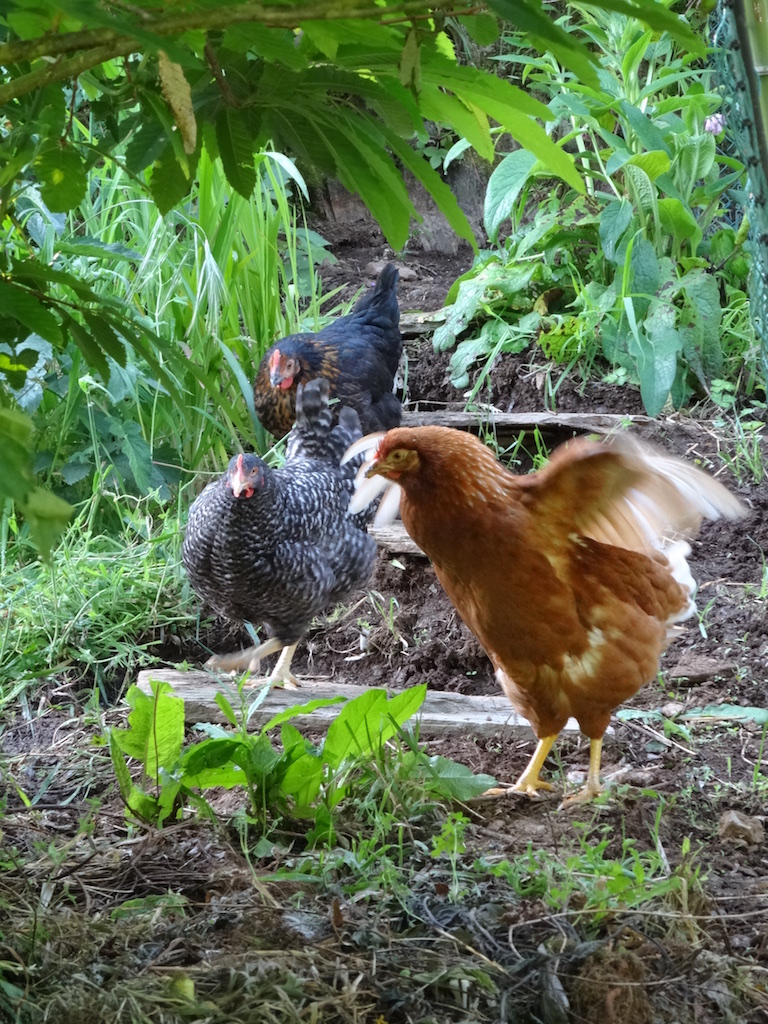
I would love to free-range them, but it seems an impractical proposition. Many local birds are taken by raptors. Foxes are a widespread problem, as are wild cats, genets and pine martens. Mongoose are in the area. On top of that, there is the ever-present threat of uncontrolled local dogs helping themselves to a free meal (and in fact we lost our entire flock to them in 2014 when they managed to open the gate to the compound).
We’ve experimented with moving them around with chicken tractors and electric fencing. While the electric fencing worked very well to keep out 4-legged predators, it was no barrier to the winged ones and we were forced to abandon the idea. At the moment, our birds live in a compound again, currently guarded by 2 geese. The idea was to be able to free range them if the geese proved good guardians. They did. So good that they’re not safe to free range …
We’re considering the possibility of a couple of goats or sheep for milk, manure and overgrowth control, but this is more a medium to long-term aim.
Forest
When they wrote Permaculture One in 1978, Bill Mollison and David Holmgren already knew, from their experience of Australian bushfires, that nutrient-rich forests of food-producing tree species – one outcome of permaculture design – are inherently much less of a fire hazard than fuel-rich sclerophyllous forests dominated by eucalypts or pines. Not only are they less of a hazard, they are even fire retardant.
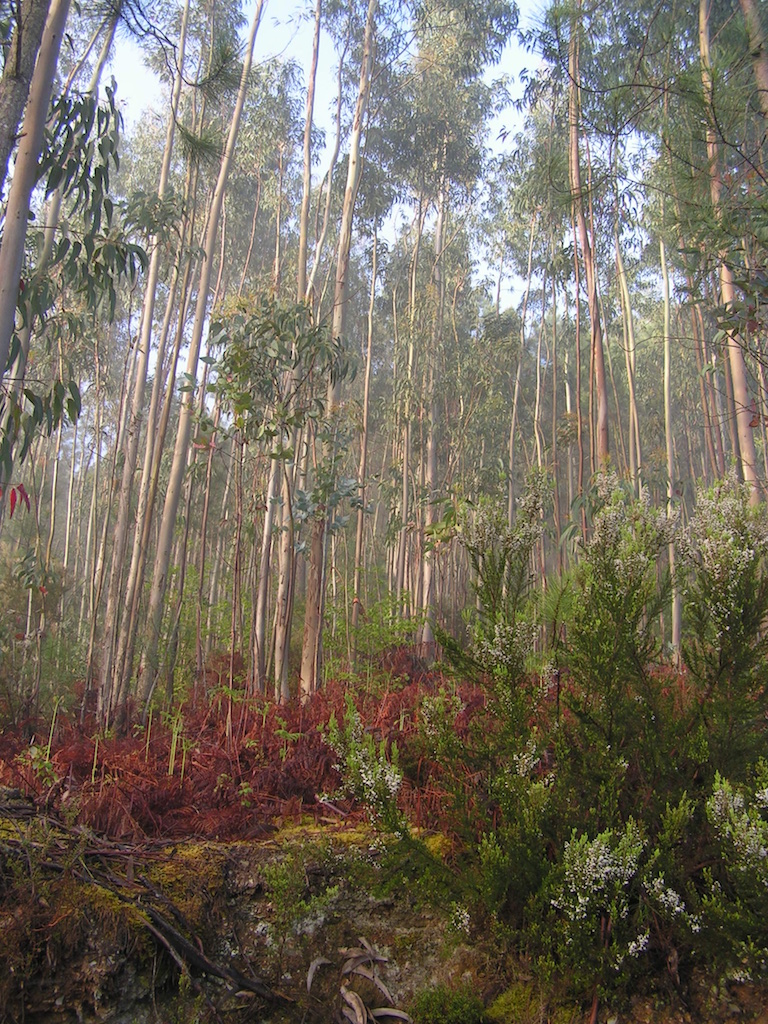
Plantation of Eucalyptus close to Quinta do Vale’s woodland
What applies to Australia applies equally to the mountains of Central Portugal. There are the same monocultures of pine and eucalyptus – the exact same species, in fact, as are planted widely in Western Australia. Portugal imported the eucalyptus (Eucalyptus globulus) from Australia (the first 35,000 trees were planted in the Mondego valley in 1866) and Australia imported the Maritime or Cluster pine (Pinus pinaster) from Europe (beginning in 1896). And there is the same problem with devastating forest fires.
The consequences of being surrounded by two of the most volatile and flammable species of tree on the planet mean that for us, permaculture principles are a lot more than just a sensible and sustainable way to grow things. The fires of October 2017 dramatically underlined this and as we watch the land recovering, it’s gratifying to see the difference we’ve been able to make.
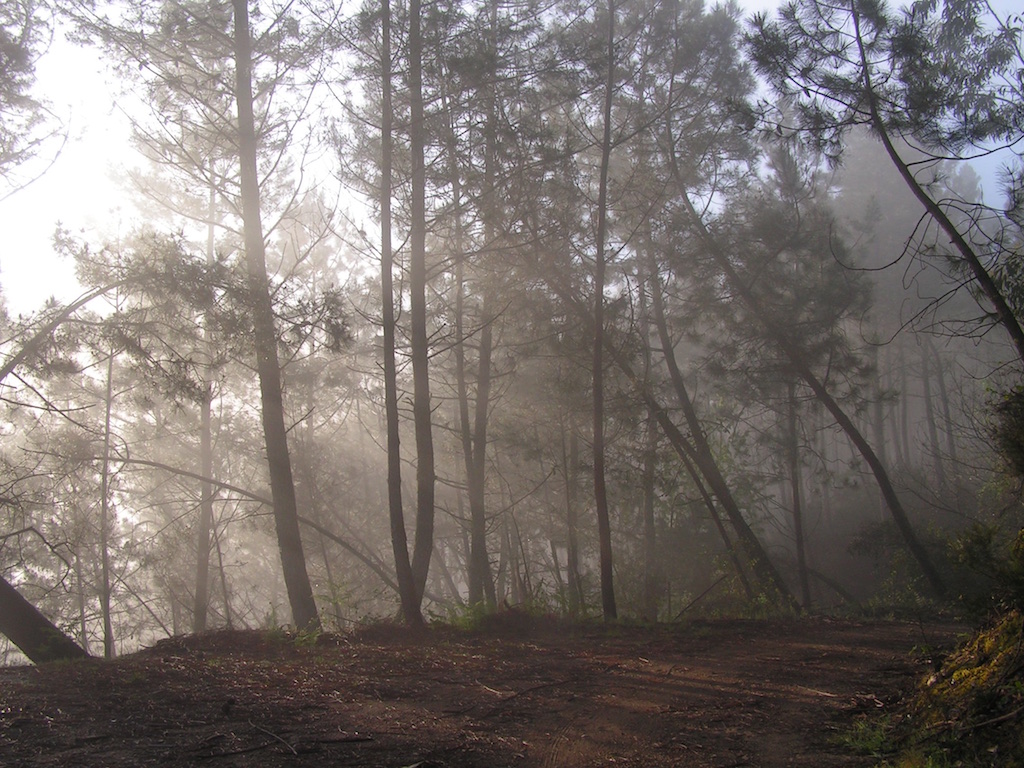
Quinta do Vale’s pine woodland (Pinus pinaster)
Quinta do Vale’s bit of forest, around half a hectare (1 acre), is mostly comprised of Pinus pinaster, but stands of eucalyptus are not far away. The massive boles of three ancient sweet chestnuts (Castanea sativa) shows what used to grow here. One of the first things we intend to get to grips with is increasing the native biodiversity, fertility and moisture-retaining capacity of the forest. There are some chestnut and oak saplings amongst the pines and we will be removing the pines surrounding them and encouraging the regeneration of the indigenous understorey to restore fertility to the soil and support the saplings’ growth. (I also find the whole idea of forest gardens much more exciting than annual vegetables.)
There are also many young oaks and sweet chestnuts growing on the terraces and slopes between them and we are progressively extending this planting, adding a good mix of other species, and coppicing appropriate varieties once they’re of an age to do so.
While we’re introducing some trees and shrubs which are not part of the local ecosystem, we’ll be aiming to maintain about 70% native species in order to encourage the regeneration of all the local ecosystem interdependent relationships between plants, insects, birds, reptiles and mammals.

Old chestnut trees in Quinta do Vale’s woodland
Chestnuts have a preference for north-facing slopes and they grow particularly well here. There’s a lot of bracken-covered slope which had only sparse tree cover to begin with, which we planted up early on, progressively working up into the forest as we thinned the pines, using the spindlier trees for constructing things like compost bins and the larger specimens for firewood for the woodburning stoves. Pine wilt nematode is active in the area, so our eventual aim will be to remove all but a few of the most vigorous and healthy specimens of Pinus pinaster, planting some Stone pines (Pinus pinea) instead because they’re both resistant to pine wilt nematode and the main source of edible pine nuts.
We aim to be self-sufficient in firewood and any timber we need for cultivation, construction, etc. Sweet chestnut will provide structural timber, and for cultivation support and firewood we’ll be using some Black Locust (Robinia pseudoacacia).

Black locust – Robinia pseudoacacia
Robinia species were once native to Europe in the Eocene and Miocene according to the fossil record, but the genus is now confined to North America. The tree is extensively naturalised across Europe, North India and Nepal, valued for forage and timber, and is the mainstay of commercial honey production in Hungary. It has several great advantages. It grows very rapidly, survives droughts and frosts, tolerates infertile and acidic soils, and produces livestock feed nutritionally equivalent to alfalfa, It’s a member of the Fabaceae (pea) family, and like other legumes, has nodules on its roots which host nitrogen-fixing bacteria, helping to restore fertility to soils which have been depleted and impoverished by the pine and eucalyptus. It produces fragrant racemes of flowers attractive to bees who turn its nectar into good quality honey. The heartwood is infused with flavonoids which make the wood highly resistant to rot – perfect fence-post and vine support material. It can endure for over 100 years in the soil. It’s a very heavy and hard wood, and makes excellent firewood for wood-burning stoves; it burns slowly, with little visible flame or smoke, and has a heat output comparable to anthracite. Finally, it coppices well and grows even faster after the first cut. (Thanks to Andy Hill at Quinta das Abelhas for introducing me to this tree.)
Other deciduous trees on the list to bring the woodland into a better balance are …
- Italian alder (Alnus cordata) another fast-growing nitrogen-fixer tolerant of dry conditions with edible sap and useful wood.
- Hazel (Corylus avellana) which is already growing here for its nuts and poles.
- Lime (Tilia cordata) for its edible sap, leaves and seeds, and the high nutrient value of its fallen leaves.
- Poplar (Populus alba) for its fast growth and the light shading provided by its canopy which allows a diverse and healthy understorey to develop protected from the relentless strength of the summer sun.
- Hornbeam (Carpinus betulus) for its shade-tolerance and valuable timber.
- Birch (Betula pubescens), Ash (Fraxinus angustifolia), Cork oak (Quercus suber), Holm oak (Q. ilex), English oak (Q. robur), Pyrenean oak (Q. pyrenaica), Rowan (Sorbus aucuparia), Holly (Ilex aquifolium), Wild cherry (Prunus avium) and Portugal laurel (Prunus lusitanica) among others.
As important as the trees themselves is the understorey. Here we’re planning to grow edible shrubs like elderberry (Sambucus nigra), mulberry (Morus nigra), the local medronheiro (strawberry tree Arbutus unedo), hawthorn (Crataegus monogyna), Bay (Laurus nobilis), myrtle (Myrtus communis), blackcurrant, redcurrant, billberry, raspberries, brambles (yes, brambles!) and goji berry, and shade-tolerant mineral-accumulators, nitrogen-fixers or medicinal plants like Liquorice (Glycyrrhiza glabra), Oregon tea (Ceanothus sanguineus), Comfrey (Symphytum officinale) and Witch-hazel (Hamamelis virginiana).
There’s one other “pine” I’ve planted here, though it’s not a member of the Pinaceae. This is the self-coppicing Wollemi pine (Wollemia nobilis), one of the world’s oldest and rarest trees, thought long-extinct until discovered in a canyon in Australia’s Blue Mountains in 1994. There are only 100 or so specimens left in the wild, and the oldest known fossil of the tree has been dated to 200 million years old.

Wollemi pine at Quinta do Vale
In order to protect them (their exact location is a well-kept secret), the tree has been propagated extensively and made available worldwide with all sales helping to finance its preservation. No two Wollemi pines grow alike. It has no value for firewood, building or food, but it’s a tree who’s spirit I really like, and it’s as important to care for the spirit of the forest as its material existence. I spent 3 months or so in close association with this remarkable tree through a homeopathic pathogenetic trail or ‘proving’ and got to know it pretty well. Wollemi is an Aboriginal word meaning “look around you, keep your eyes open and watch out” – exactly what we need to do in order to learn how to work with nature, not against it. It’s all about survival and renewal; about knowing who you are, believing in your worth and taking your place in the world. In Traditional Chinese Medicine, this is “Lung” function, and the tree (as with other members of the Araucariaceae) is a great atmospheric purifier, as well as having leaves resembling gills and bark that looks like the alveolar surface of a mammalian lung.
And since we’re surrounded by trees equally at home in Australia, it seems somehow fitting that a Wollemi pine should be planted here.
The fires
The unprecedented scale and ferocity of the October 2017 fires which devastated 2,000 square kilometres of Central Portugal inside 24 hours, also devastated our trees. Not one pine tree survived. One of the old chestnut trees which survived the fires 30 years ago was completely burned. It’s too early yet (March 2018) to know whether the others will recover. Or any of the other trees for that matter.

Quinta do Vale after the fires of October 2017

We replanted a few trees and sowed some chestnuts and acorns, but with the soils so hydrophobic and the spring rains so intense, most of the rains ran straight off. We check-dammed the slopes with dead trees to help hold the soils and these worked well, but slowing the water is not so easy. Bedrock is only 20-40cm below the surface in most places. The soils on the steeper slopes were still bone dry beneath the surface by the end of the Spring rains.
The hydrophobicity of the soils persisted for two years. Only in Autumn 2019, when welcome rains – more than we’ve had for many Autumns – came, did they finally manage to soak deeply into the soil again.
So now we replant in earnest. You can help us by sponsoring trees and shrubs, particularly native species and the more unusual species for our food forest, and by helping us supercharge the poultry compost-making process.
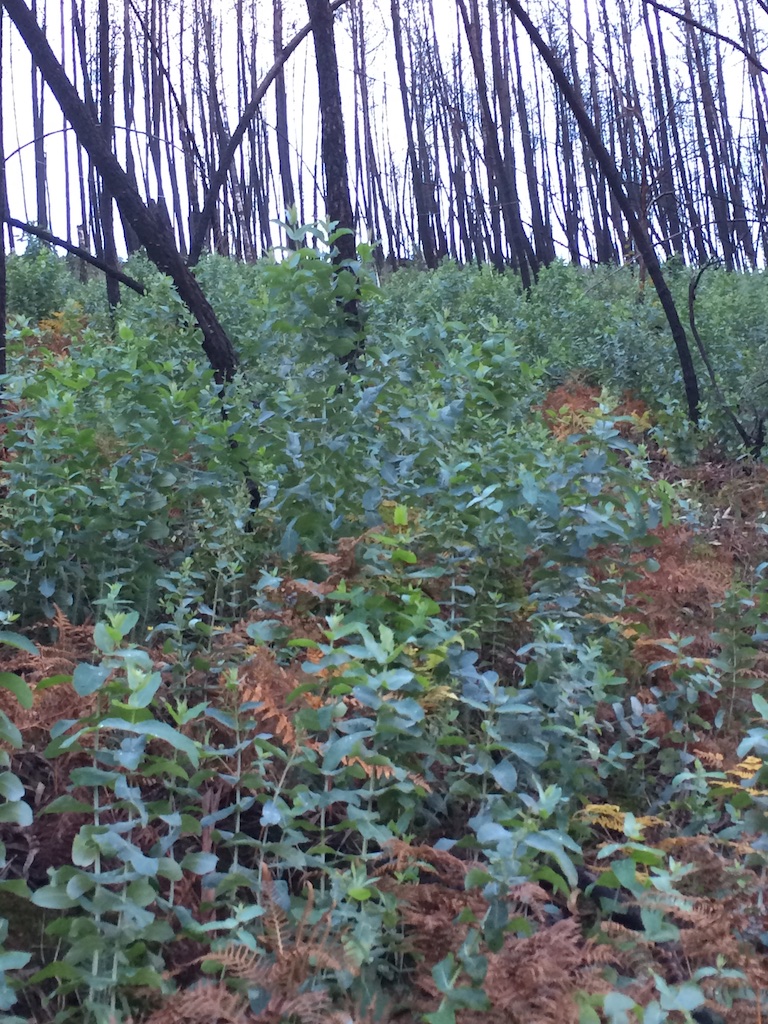
Neighbouring pine plantation covered in Eucalyptus seedlings
Longer term, we would like to purchase a section of slope above the quinta which forms a wedge between the two areas of woodland belonging to the quinta. The owners of this pine plantation – now completely burnt – planted Eucalyptus trees along one of their borders and those trees have now completely covered the slope with fire-sown seedlings which the owners show no inclination to remove. The trees are far too dense to survive for economic conversion, but meanwhile are doing what Eucalyptus does so well – getting their tap roots down into the groundwater. This not only compromises the viability of the slope but presents a huge fire hazard once they reach reasonable size. Having management of this whole section of slope would allow us to put in water and soil-retention landscaping and restore the valley side to native woodland.
Click/tap on any image for more details of each project


