
Click on this link for all the posts on renewable energy >
We are mostly self-sufficient in energy. This is quite a challenge in view of the capital outlay required for some components of small scale renewable energy generation systems. Far greater efficiencies are achieved at the level of micro grids, powering small communities. With the number of people moving into this area, it’s something to be considered for the future. For now though, solutions remain individual.
Electricity
The quinta’s aspect varies from northwest through north right round to south east, though being situated one third of the way up the eastern slopes of a mountain ridge with a ridge also to the south, most of the site is effectively north-facing in winter and only really open to the east. This makes solar power less than optimal in the winter months. The solar panels are positioned to maximise winter sun, but at winter solstice they still only receive 1 hour 50 minutes of direct sunlight.
We’re lucky enough to have year-round water in the stream in all but exceptional years and a total of 30m potential head, 15m of that at an angle steeper than 45%, but the flow can be minimal by the end of the summer. If the autumn rains fail, as they have been increasingly since 1980, flow can also be minimal through until spring. In these circumstances, we do still have to resort to using a backup petrol generator on occasion.
Hydro-electricity
The hydro part of the equation is reasonably straightforward and the schist-built storm drain, which diverts stream flow from the underground water channels running through the terraces, is almost purpose-built for the installation. I looked at a number of turbine options, but finally opted for a locally-designed water wheel. Very local. From 250m down the hill in our nearest village, Benfeita.
Having tried various run-of-river solutions for his valley floor site at the old lagar (olive mill) and experienced endless problems with debris in the river, engineer Wayne Sutton hit on the idea of using an over-shot water-wheel to drive a permanent magnet generator from a wind turbine, appropriately geared.
To me, this system is pure genius.
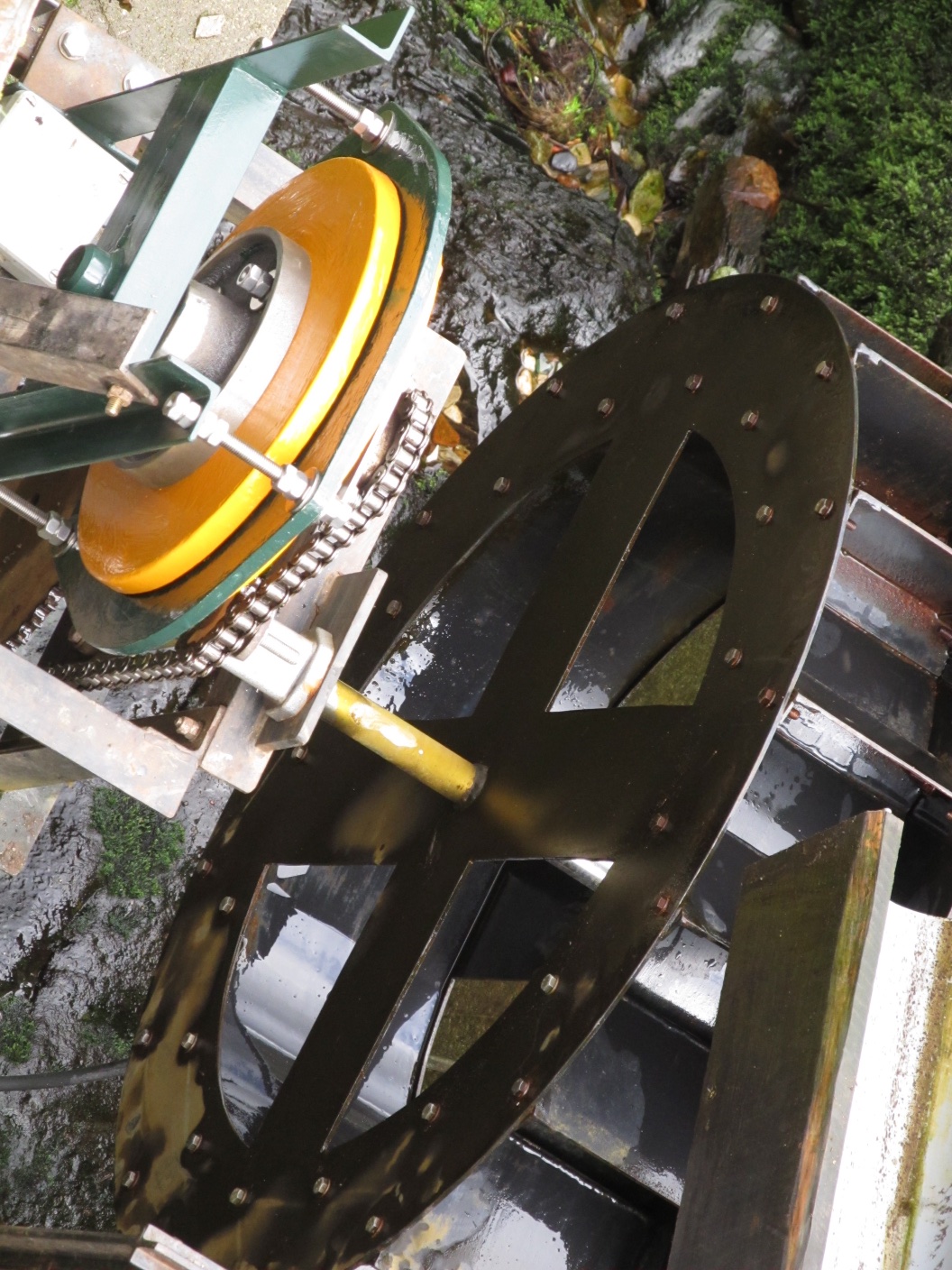
The key is that it’s an open system. Unlike a turbine which is a much more closed system supplied by a pipe rather than a chute, the wheel deals with whatever the stream throws at it. There are none of the problems of suction and cavitation which turbines experience when flow rates drop below a critical level. Minimal civil works are necessary to deliver the stream flow to the wheel with no damming of the flow necessary, unlike turbines which require a feed pipe or ‘penstock’ and generally a small dam, or collecting pool fed from the main stream, to fill it. The wheel effortlessly, if noisily, handles the tons of mud and rocks which occasionally come flying down the mountainside following downpours and there’s no necessity for grates, screens or filtration devices and their associated maintenance, or problems with clogged nozzles and blocked penstocks. Gearing can be changed to suit different flow rates if they are hugely variable, though we’ve never found it necessary.
After a long-running saga trying out a number of different alternators to generate power from the wheel, including a war of words with an American supplier whose alternators very definitely didn’t live up to his claims for them (and whose websites have since disapppeared), we finally opted for a Hugh Piggott-designed 48V axial flux alternator, built locally by a friend. This was eventually installed in early 2014. Over the next few months it kept the batteries of both systems on the quinta fully-charged, generating anything between 40-200W continuously, depending on stream volumes. It’s capable of producing much more and we’ve seen it up to 400W, but that’s nigh on maximum capacity for the delivery chute. Not to mention that we’ve no way of using so much power!
You can follow the detailed progress of our installation with facts and figures through blog posts on the subject, but here is the wheel generating winter power for us.
Solar power
With our water wheel-based hydro system, we were initially hoping it would be possible to relegate the solar component to a more secondary role in energy generation. We initially installed a 24V system with only half the generating capacity originally envisaged, but with the lack of rain through winter 2010-11 and the trials and tribulations sourcing an appropriate generator for the wheel to match our water availability, we upped our solar generation to the original planned capacity in early 2011.
We added a separate 12V system for the smaller building in 2013.
In 2016 we added a further couple of panels to the main 24V system to take more advantage of winter sun.
When all of the 24V system panels burned in the fires of 2017, we replaced them with 6 x 265W for a total generating capacity of 1.6kW. While that might be regarded as overkill for the 770Ah battery bank, it makes all the difference in the winters when we have no hydro. Solar panels have come down so much in price in the last decade, it’s now very economical to increase capacity. The 6 panels which now supply our power together cost less than the original 2 in 2010.
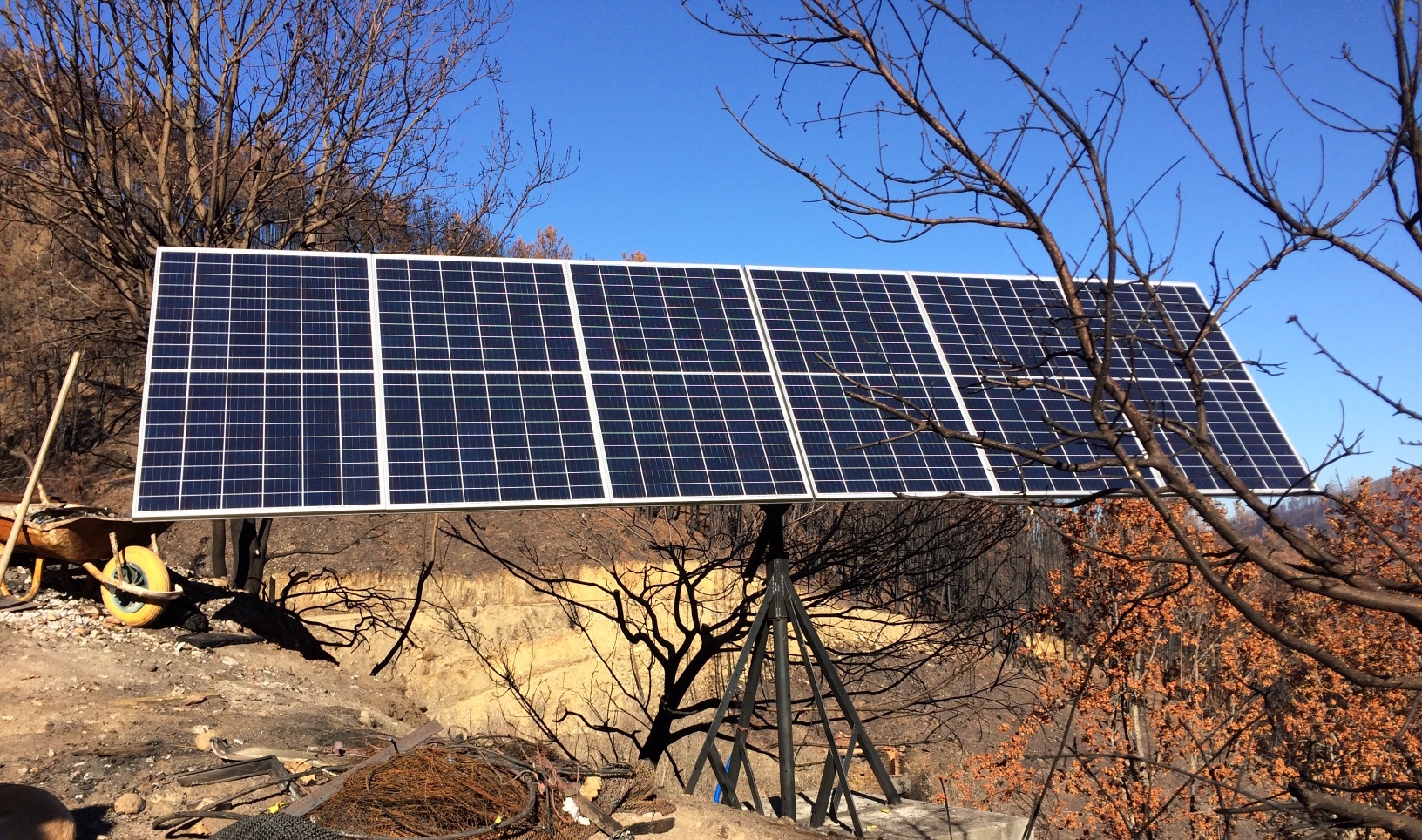
The 12V system amazingly survived the conflagration that destroyed the wee house and all we had to do to get the system back online was to replace some burned out cables.
Water heating
We use a combination of solar water heating and wood-burning water heaters to provide hot water year round.

The solar heaters are simple 100m coils of black water supply pipe. A 100m coil of 40mm MDPE will hold almost 80 litres of water, so the water heaters are also the water storage. A generous couple of showers can be had with a full coil and the cost is around one tenth of your average evacuated tube system with integral storage tank. There are advantages to the latter, of course, like being able to shower when the sun is no longer on the collector, but the cost savings are persuasive.
Winter hot water is provided by wood-burning bailarinas. These are identical to the old German badeofen, and are still manufactured in Portugal, so easily obtainable.
Cooking and space heating
This is provided by wood-burning stoves and masonry heaters.