Click on this link for all the posts on building >
We’re working with the existing two buildings on the quinta substantially as they are, recycling and reusing existing materials as much as possible, working with traditional building techniques – both local and from other traditions – and sourcing materials as locally as possible. The idea is to adapt our lifestyles as much to suit the existing structures as the other way round.
The larger of the two buildings is being renovated to form the communal hub of the quinta with kitchen, store room, social/classroom space, library/music room/office, and an open workshop under the back roof. The smaller building (the ‘wee house’) was and will be again (see ‘The fires’ below) self-contained accommodation with bedroom plus ensuite shower, living room and outside kitchen. This is both for my own use and for volunteers/visitors/guests. Both buildings have independent power generation systems, rainwater harvesting and grey water purification. The wee house has ecological sanitation.

Greywater processing greenhouse extension to the communal building
Structural renovations are focused primarily on making the buildings wind and water-tight, comfortable in all seasons and weathers, and resource-efficient. Where possible, synergistic functionality is being designed in to extend usability, add flexibility, contribute to resource efficiency and confer a greater degree of autonomy in building systems by closing some of the resource use loops involved.
A lot of big words to describe a general principle, but what do they mean in practice?
I’m looking for opportunities to meet as many challenges as possible within a single elegant and cost-effective solution, while avoiding loss of flexibility as much as possible. Generally it’s about keeping it simple and low tech. That may mean some compromises and loss of convenience, but humans are generally much more flexible and adaptable than buildings.
For instance …
- building the roof out over external staircases either side of the communal building results in no loss of internal space to accommodate staircases, and the dry stone walls are sheltered from driven rain and summer sun
- installing a bathroom in the geodome greenhouse provides humidity and irrigation from grey water, while the greenhouse helps heat the water for the bathroom
- closing off the open half of the communal building with a glazed extension adds grey water processing capability, winter food growing, passive solar heating and classroom space
Does it make sense to put far more embodied energy into the construction of a home (materials, manufacturing processes and investment in terms of wo/man-hours needed to achieve and pay for the end result) than would ever be saved in resource efficiency and convenience throughout its lifetime? This question occupied me for a while until coming up with a solution which made sense.
So I’m exploring a more distributed, decentralised idea of ‘house’ here: partly because of the limitations of the existing buildings, partly because of the appeal of the concept itself, and mainly because I want to develop the quinta into a demonstration site hosting workshops and courses as well as being my home. This creates a need to balance privacy considerations with utility and resource efficiency through the different seasons and the ability to cater for larger numbers of people at certain times of the year.

The interior of the wee house as it was
The communal/social functions of a home, together with classroom-type space, will eventually be grouped together in the one building, but the more private spaces like bedrooms, bathrooms, etc, are/will be dotted all over the land in the form of small natural buildings and more temporary/seasonal structures. Essentially the whole farm becomes part of the ‘house’.
It’s a very flexible arrangement. ‘Rooms’ can be added and removed or repurposed as required. Everyone has their own personal and peaceful space that’s detached and distant from the communal space. Buildings are either temporary or small and, despite requiring more materials in aggregate than a centralised alternative, can be constructed sustainably from natural materials mostly sourced onsite in easy bite-size chunks. Larger numbers of people can be accommodated in summer with the addition of seasonal rooms in the shape of tents and tipis.
There’s also flexibility to create synergistic relationships between rooms, like the bathroom-greenhouse combination mentioned above.

The wee house kitchen
This arrangement of living space does mean there are times when we have to leave a cosy warm living room and step into the teeth of a gale to go for a shower or to bed, but that’s actually part of the point. Once this way of life becomes ‘normal’, then the teeth of a gale becomes a perfectly acceptable thing to step out into. Just another natural phenomenon doing its thing in the corridors of the ‘house’. It blurs this conceptual separation we have between ‘home’ and ‘out there’ until eventually it ceases to exist.
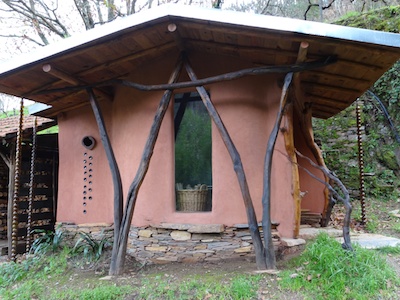
The cob bathroom
The fires
The inventory of damage from the devastating fires of October 2017 is extensive but fortunately not total.

The wee house and kitchen

The volunteer caravans
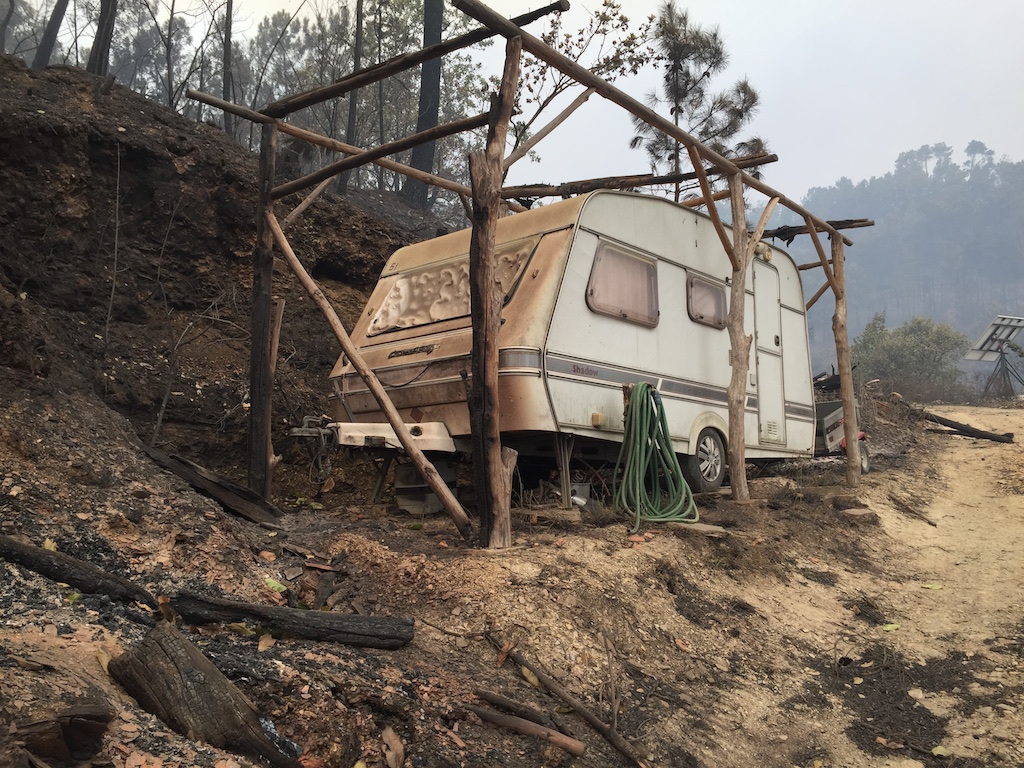
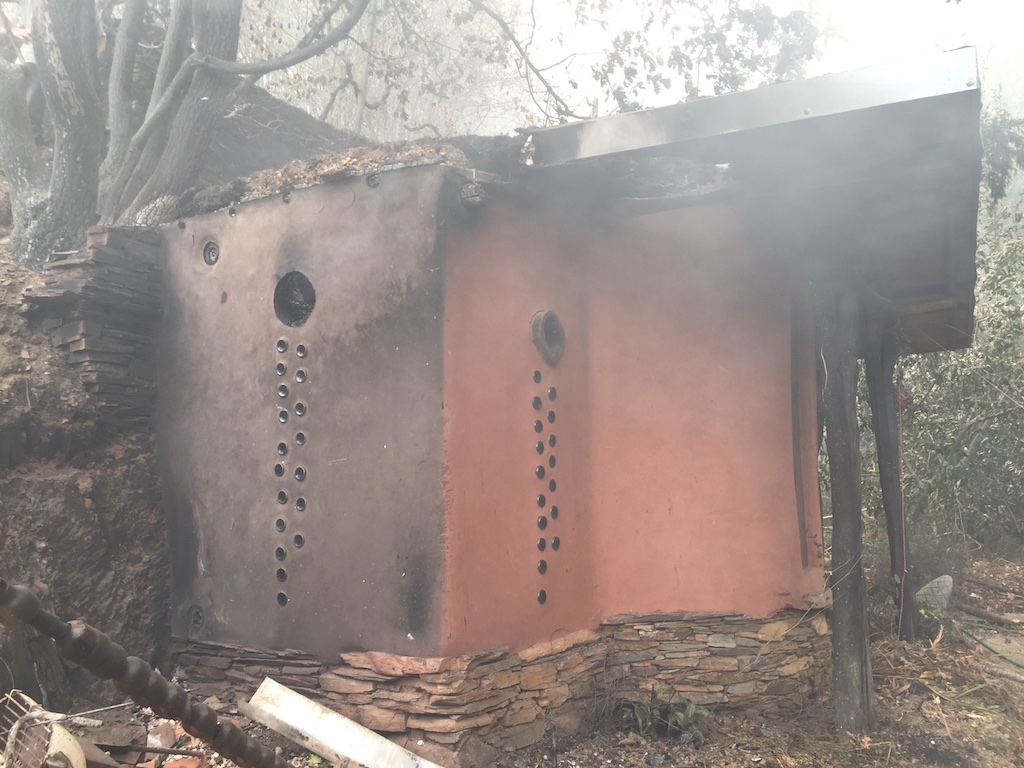
The cob bathroom
- The wee house and kitchen were destroyed.
- One volunteer caravan was completely destroyed and the other had its windows melted.
- The cob bathroom was damaged – one half of the roof will have to be stripped down and rebuilt, a wall reconstructed and a window replaced – but it remains useable.
- The geodome greenhouse was burnt out but the framework is still intact.
- The communal-building-to-be, still under construction, escaped with a couple of cracked windows.
- The yurt and poultry coops survived unscathed.
The buildings were all uninsured because none of them were completely finished and I’d been told I couldn’t get insurance on unfinished buildings. The Portuguese government compensation payouts amounted to less than €5,000 against losses of around ten times that amount. Plans to start running courses here in 2018 had to be shelved. After 18 months of gruelling paperwork, the rebuilding of the wee house (financed by EU disaster relief funding) was finally approved and work began in 2019.
The remaining damage was not eligible for help. But I will find a way to rebuild. We will put this quinta to rights again. If you’d like to come and join in, or help out from a distance, please see the Get Involved page.
We are inviting sponsorship for individual building projects …
Click/tap on either image for more details of each project