
Quinta do Vale is part way up a mountain in the Serra do Açor in the municipality of Arganil, Central Portugal. It’s about 75km (45 miles) inland from the university city of Coimbra, Portugal’s 12th century capital. The nearest town, Côja, is 8km north.
The quinta’s 2-ish hectares (5 acres) of steeply-terraced land lie between 360-420m (1,200-1,400 feet) above sea level. The land snakes around a small stream valley so aspect ranges from NW through N round to SE. Slopes vary between 30-45°.
Locality
This is the “Green Heart of Portugal” – natural parks and forested mountain ranges cut deep by meandering river valleys, peppered with tiny white villages perched on mountain ridges or towns nestling in the valley floors of the larger rivers. Every available square meter of land is terraced and was, at one time, richly cultivated with olives, vines, fruit trees and vegetables.

Fraga da Pena
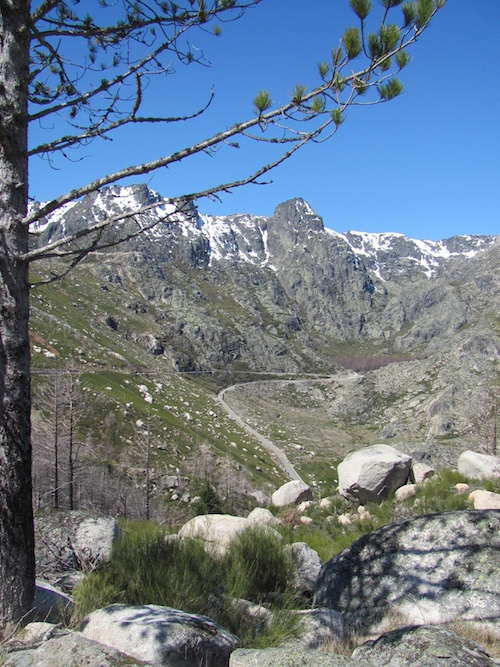
Parque Natural de Serra da Estrela
We’re within walking distance of the waterfalls of Fraga da Pena and the indigenous forest reserve of Mata da Margaraça which are both within the Paisagem Protegida da Serra do Açor, a larger protected area forming part of this enclosed valley system.
These valleys, mostly all part of the freguesia of Benfeita, are surrounded by watersheds in all directions except north. It gives a sense of containment to the area, as well as physical separation from the surrounding landscapes. There are several rare species within the Mata da Margaraça and carefully protected there. These include the largest number of azereiros (Prunus lusitanica ssp. lusitanica) left in Portugal, relicts from the laurel forests of the Tertiary period in geological timescales.
The quinta is also less than 20km southeast of the Parque Natural da Serra da Estrela (Mountains of the Star), Portugal’s largest natural park and highest mainland mountain range.
Piódão, one of the “Historical Villages of Portugal” with all its buildings restored in their original schist and slate and now a popular tourist destination, is around 10km away, though nearer 30km by road.
Quinta do Vale
Quinta means ‘farm’ in Portuguese, as in a small farm, smallholding or homestead; Quinta do Vale means ‘Valley Farm’. It overlooks the village of Benfeita (pron. Ben-fay-ta, and thought by some to mean “well made” – bem feita in Portuguese – though others speculate about an Arab origin). Benfeita is one of the designated aldeias do xisto (schist villages) of the Serra do Açor (Mountains of the Goshawk).
A forest access track runs through the land, dividing it between mostly cultivation terraces (below the track) and woodland (above). The woodland is mostly pine plantation with the odd chestnut, oak and eucalyptus.
Quinta do Vale’s two buildings were constructed as agricultural storehouses with animal shelters below. Both are set into the mountainside, cut into the solid rock which forms the rear walls of the ground floors, and built from thick dry-stone walls of schist, the bedrock of this area. In contrast to so many in the area, the walls were sound and the roofs still intact, even if not fully watertight. We are slowly turning them into facilities to support our re-envisioned concept of ‘home’ and what it means to live, work and share a life more in tune with natural rhythms and processes.

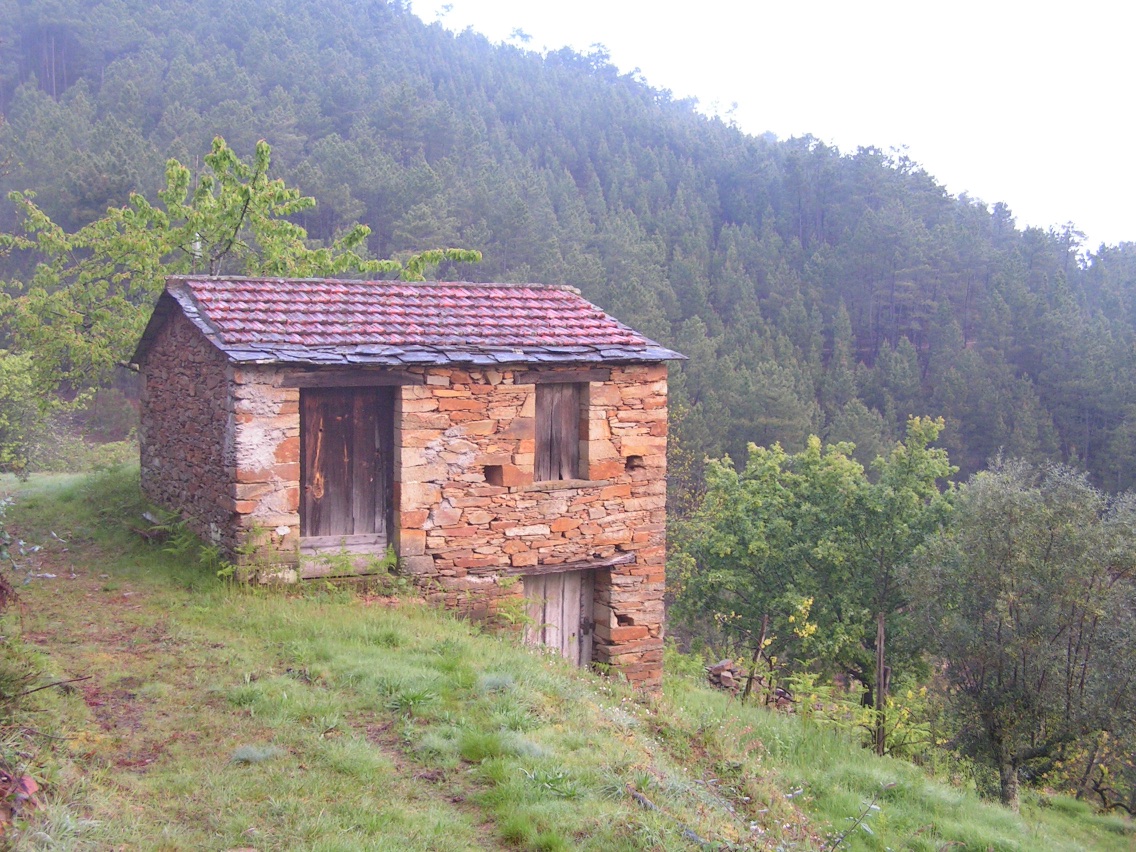
The two buildings on the quinta at the time we bought it
The steep terraces are also built from dry-stone walls of schist with steps leading up and down from every level. The amount and quality of stonework in this region is stunning. It goes far beyond the simply utilitarian, expressing a centuries-old bond between people and place in its artistry and enormous sophistication in its engineering, which owes its origins to the Arab civilisation and has its roots in the Moorish occupation of the Iberian peninsula.
This is reflected in constructions like the beautiful hand-built raised schist paths, with integral irrigation channels, which snake their way along the valley floors. The 5km Caminho do Xisto between Benfeita and Sardal is a fine example.
Terraces are not merely walls holding back soil, but contain underground networks of slate-built irrigation channels, storm drains and water collection and filtration systems. This is integrated engineering for whole valley systems, not merely individual properties. Each terrace follows Keyline principles, gently graded to transport water from valleys out to ridges, and contoured so that water takes the longest possible diagonal route across them before draining off. Nobody locally seems to know how old this stonework is, though some can point to sections built by parents and grandparents, but it will have been constructed over many generations in a continual development for at least 1000 years.
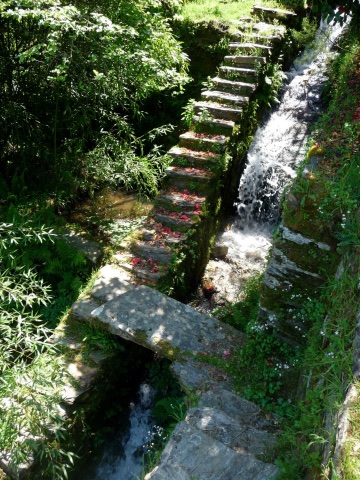
Steps alongside the storm drain
Quinta do Vale’s terraces have olives, nuts (chestnuts, almonds, walnuts, hazels), and all kinds of fruit (lemons, oranges, tangerines, loquat, cherries, kiwi fruit, persimmons, apples, pears, quinces, apricots, peaches, plums, damsons, pomegranates, strawberries). Grapes line every terrace and there’s a little vineyard as well.
A small spring-fed mountain stream which apparently had never run dry (though it did in the summer of 2012) flows through the middle of the property and the terraces snake their way in a rough S-shape around it. Part of the water flows in a series of underground schist-built channels, filling collecting pools on each terrace, which then feed levadas or irrigation channels. A schist-built barroco (channeled stream) with steps down its entire length runs parallel to this through the quinta, functioning as a storm drain and carrying the remainder of the water on down the valley to the river that runs through Benfeita.

Waterfall into one of the collecting tanks
Many streams in the area run dry every summer, so we’re very fortunate to have year-round surface water in all but exceptional conditions as well as the ability to make the most of water retention landscaping to rehydrate the soils. The sound of a little waterfall below the main house is constantly audible. Where the stream runs through, the terraces are wider and there’s room for our 5.8m Mongolian yurt.
The land had been largely abandoned and was neglected and overgrown for at least a decade before we took it on. Much of it was covered in the dreaded silvas – the brambles which quickly overtake any neglected land in Portugal – and bracken, hinting at past fire damage (forest fires are a regular summer hazard here), but the extent of overgrowth had been kept in check by reasonably regular cleaning and was minor in comparison to the state of wholly neglected land. The terrace walls are mostly sound and the soil in the stream valley good, fertile, deep and comparatively stone-free: a perfect site for our permaculture project.
With the resources onsite we are mostly self-sufficient in power (hydro + solar) and heat (solar hot water + enough forest to produce sustainable supplies of firewood while still being able to restore native deciduous species) as well as food and water. We’re not connected to the grid. Portugal has good telecomms coverage and we have reasonable wireless internet on site so we can stay in contact with the rest of the world and continue our online work and activities as well as farming our land.
We’re developing ecological sanitation with both dry and flushing compost toilets, the latter a design now approved by our local municipality and open sourced.
Community around Quinta do Vale
The villagers of Benfeita and neighbouring Luadas, Pai das Donas and Pardieiros are warm and friendly and we’ve felt very welcome here. A community of estrangeiros lives locally and since moving here, that community has grown exponentially, both around Benfeita and further afield. After decades of depopulation (the Portuguese call it ‘desertification’), people are moving into the area again.
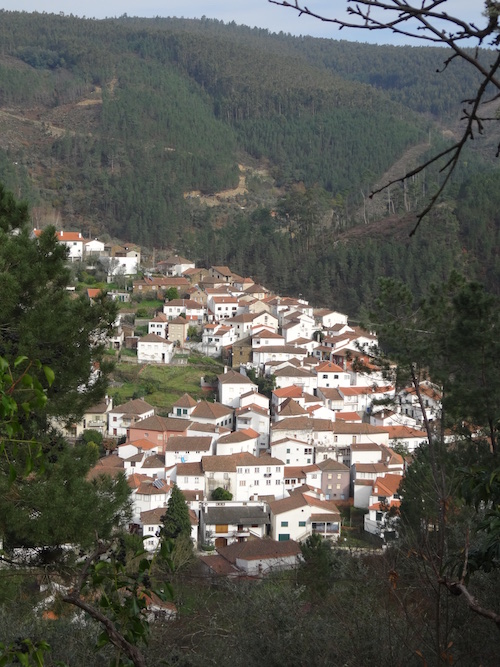
The village of Benfeita below Quinta do Vale
Since 2001, EU funding under the Aldeias do Xisto Program has helped with the installation of basic infrastructure like sanitation, water and electricity, street-lighting, restoration of public and private buildings, and preservation and promotion of the unique heritage of the area. This heritage is still very much alive. With many of the more remote mountain villages having only sporadic contact with the outside world until relatively recently (60 years or so), traditional techniques are widespread in living memory. The Portuguese have been quick to adopt modern chemical approaches to agriculture, but scratch just below the surface and all the old ways resurface.
Beyond the immediate locale, there is a vigorous and growing community of people of all nationalities in Central Portugal pursuing the principles of permaculture on their own quintas and organising themselves into mutual support networks, sharing labour and ideas (see Ecosphere – Portugal links section in links for more links).
The potential here for the cross-fertilisation of ideas gathered from the cultural traditions, experimentation and experience of people from all over the world with the local environmental knowledge and still-strong traditions of the Portuguese, is one of the things that’s most compelling about this growing collaboration. It has many of the qualities of spontaneous grass-roots human self-organisation at its best (and as many challenges to be worked out as well), and promises to become an inspiring model for the necessary transition in society as we face up to the consequences of our unsustainable lifestyle and degradation of the Earth’s natural resources.